Smart Plants Workshop
A hands-on workshop in which participants build a battery-powered, Wi-Fi-connected plant monitor — and keep it.
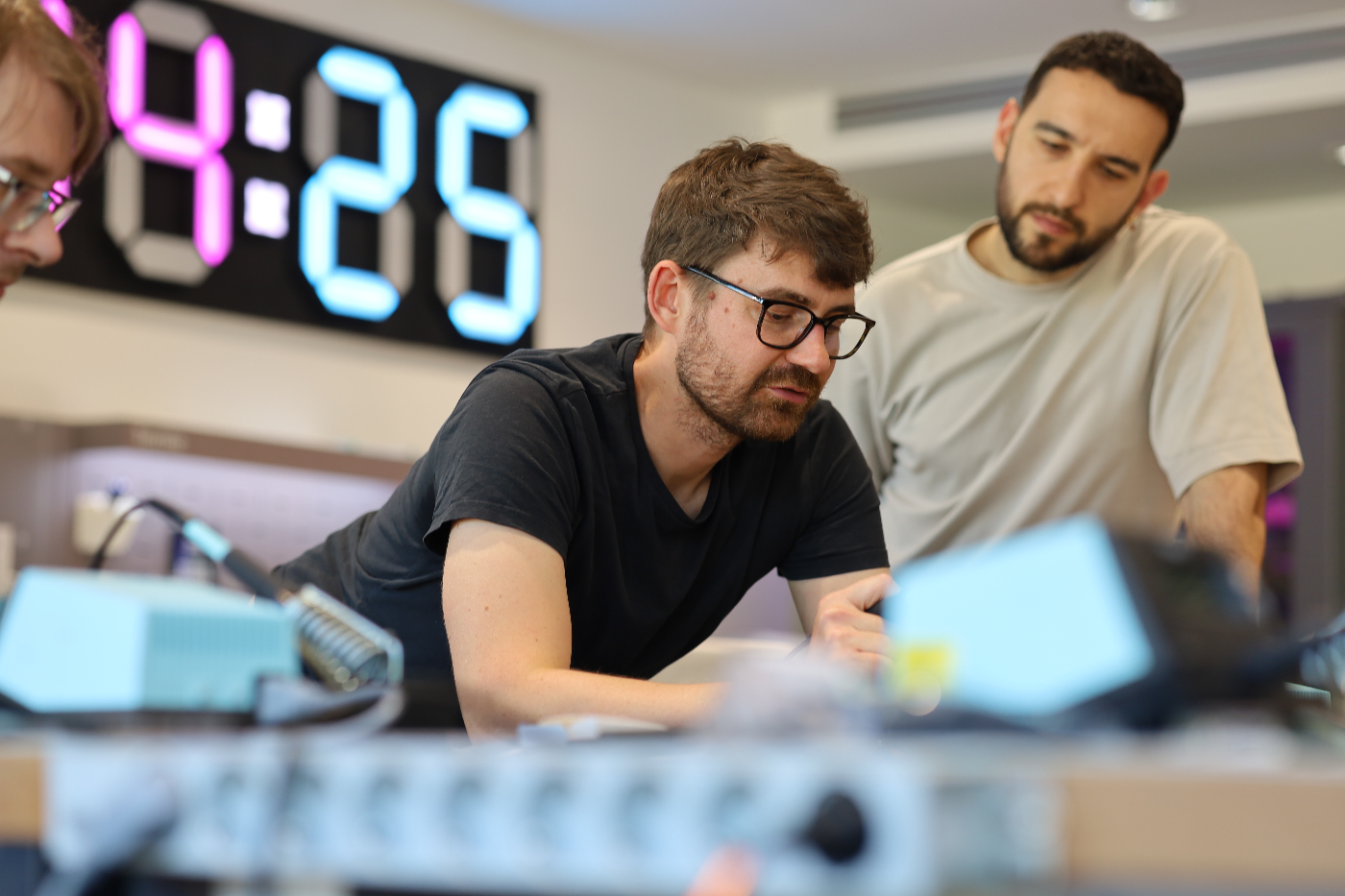
Participants build a soil moisture sensor that runs on a battery for months. The device wakes from deep sleep, measures the soil, sends the reading to an online dashboard over Wi-Fi, waters the plant if it has gotten too dry, and goes back to sleep. Along the way it covers the things that make that possible: reading an analog sensor and turning it into a meaningful value, keeping power consumption low, getting data onto a server, and seeing it arrive on a live dashboard. No soldering experience is required, though everyone gets the chance to try.
The workshop is modular and runs from about three hours up to a full day. The short version gets everyone to a working, transmitting device; the longer versions add soldering, additional sensors for temperature, humidity and light, the pump and automatic watering, and the assembly of the laser-cut and 3D-printed housing.
The Hardware
I designed the Smart Plants breakout PCB the kit is built around. It carries a Waveshare ESP32-C6 Zero and connects the capacitive soil moisture sensor, the BME280 and TSL2591 sensors, the pump and the battery — turning what used to be a breadboard full of jumper wires into something a beginner can assemble and keep using afterwards. Firmware installs straight from the browser, and everything specific to a device — Wi-Fi, measurement interval, moisture calibration, which sensors are attached — is configured on the device itself through a setup portal, so nobody needs a toolchain to get going.
The whole kit is certified open source hardware by OSHWA under UID DE000173: hardware under CERN-OHL-W 2.0, firmware under MIT, documentation under CC BY 4.0. The build instructions include the reasoning as well as the steps — why capacitive moisture sensors instead of resistive ones, why those particular sensors, how the MOSFET pump control works — so the kit can be rebuilt, modified, or taught by someone else.
How It Grew
The workshop began as a companion to a hydroponics research project and has been rebuilt several times since, each version simpler to teach and more robust in the hands of beginners. In 2025 it ran as the opening week workshop for first-semester students at the Hasso Plattner Institute, with more than 80 participants working through it in groups.
It is also the teaching end of a longer engagement: I advise the HPI Maker Universe on a project area around DIY smart horticulture and technology-assisted cultivation, covering concept development, system design and prototyping. The through-line is making plant processes visible and actionable — connecting sensor data and environmental signals to systems people can actually respond to. A workshop is where that gets tested honestly, because a design either survives contact with eighty beginners or it does not.
Developed with and for the HPI Maker Universe, but not tied to it. The material is open, the kit is documented well enough to rebuild, and the session runs for schools, universities, makerspaces and companies alike — scaled to the group and the time available.