RAYN Vision System Camera
A compact multispectral camera for plant research that images the canopy under narrow-band LEDs instead of using filters or spectral sensors.
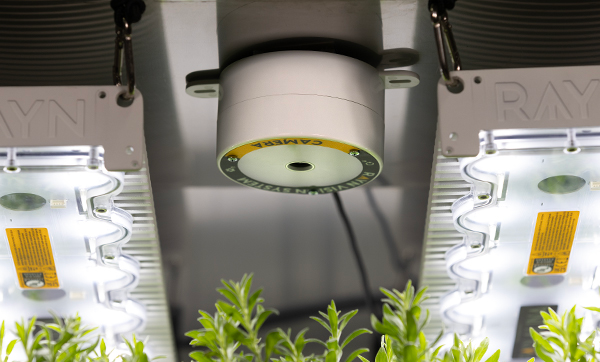
The RAYN Vision System Camera is a multispectral imaging tool for plant researchers. It sits inside a growth chamber and measures how the plants below reflect light at different wavelengths.
Multispectral imaging quantifies color differences and the ratios between wavebands, including ones the human eye cannot resolve. The images themselves are not the result: the per-band reflectance values and the indices computed from them are what allow the assessment of pigment levels such as chlorophyll or anthocyanins, and of stress effects, non-destructively and over time.
Instead of using spectral sensors or putting filters in front of a color camera, it does the opposite: it photographs a series of monochromatic images in a dark environment while illuminating the plants with different colored LEDs. Each capture produces a multispectral image cube in the standard ENVI format, ready for analysis. The camera is one module of the RAYN Vision System rather than a closed appliance — because it writes a standard format, its images can go into RVS Analytics or into whatever pipeline a lab already runs. Because the spectral selectivity lives in the illumination the camera already controls, there is no filter wheel and no tunable light source, which is what keeps the instrument small enough to work inside the chamber alongside the experiment. The camera was released in 2024 and is available as a commercial product.
My Role
I was involved from the first concept onward. That started with selecting the wavebands the camera images — the choice that decides which plant traits it can resolve at all — and testing early prototypes to characterize how the hardware behaved. From those tests I developed the calibrations that turn pixel intensity from distorted images into spatial reflectance.
Working closely with the hardware and software engineers, I wrote the specifications for the features the instrument needed, among them a standalone scheduler that lets the camera run an experiment on its own without a PC in the loop. I also shaped the camera’s openness: it sets up in three steps and runs from a web interface, but exposes its detailed settings and can be driven through a REST API, over MQTT or through hardwired input/output signals. Having worked in a wet lab myself, I wanted an instrument that adapts to an experiment rather than constraining it.